







What Coolant Works Best for Indexable Drilling: The Definitive Guide
Determining what coolant works best for indexable drilling is the single most important factor in extending tool life and ensuring process security. If you get the mix or delivery wrong, your inserts will crack, chips will pack, and the drill will fail.
I have seen perfectly programmed jobs scrapped because the operator ran a lean coolant mix on 316 stainless. The heat built up, the inserts glazed, and the drill welded itself to the part.
Coolant isn’t just “water.” It is a liquid tool.
To maximize performance, you need the right type, the right concentration, and, most importantly, the right pressure. This guide breaks down exactly how to manage your coolant strategy to drill faster and cheaper.
What Is the Primary Role of Coolant in Indexable Drilling?
The primary role of coolant in indexable drilling is twofold: thermal management and chip evacuation. While lubrication is important, the critical function is transferring the immense heat generated by high-speed carbide inserts away from the cutting zone while simultaneously flushing chips out of the hole to prevent jamming.
If you treat coolant purely as a lubricant, you are missing the point. Indexable drills run hot—much hotter than HSS twist drills.
Heat Evacuation vs. Lubricity
- Heat Removal: Water is the best conductor of heat.
- Lubricity: Oil reduces friction.
For indexable drilling, we usually prioritize heat removal because carbide inserts can withstand heat but hate fluctuation. However, without enough oil (lubricity), you get friction, which generates heat. It is a balancing act.
In my experience, if your chips are coming out blue or black, you aren’t getting the heat into the chip; you are likely trapping it in the tool.
Should You Use Water-Soluble or Neat Oil?
Water-soluble coolant (emulsion) with a concentration between 8% and 12% is generally what works best for indexable drilling in most materials. Emulsions offer the high cooling capacity of water to protect carbide from thermal shock, combined with enough oil to lubricate the wear pads and guide the drill body smoothly.
While neat oil provides superior surface finishes, it often lacks the heat dissipation required for high-speed drilling.
The Case for Water-Soluble (Emulsion)
For 90% of shops, a high-quality semi-synthetic or soluble oil is the correct choice.
- Cooling: It keeps the workpiece cool, maintaining tolerances.
- Safety: No fire hazard compared to neat oil.
- Cleanliness: Parts are easier to wash.
When to Use Neat Oil
Neat oil is superior for deep hole drilling (gun drilling) or difficult superalloys where lubricity is paramount. However, you must reduce your cutting speeds (SFM) because oil cannot carry heat away as fast as water.
Shop Floor Note: If you switch from water to oil, you must drop your RPM. I’ve seen guys run water speeds with oil and burn the paint off the machine enclosure.
Why Is High-Pressure Coolant (HPC) Critical?
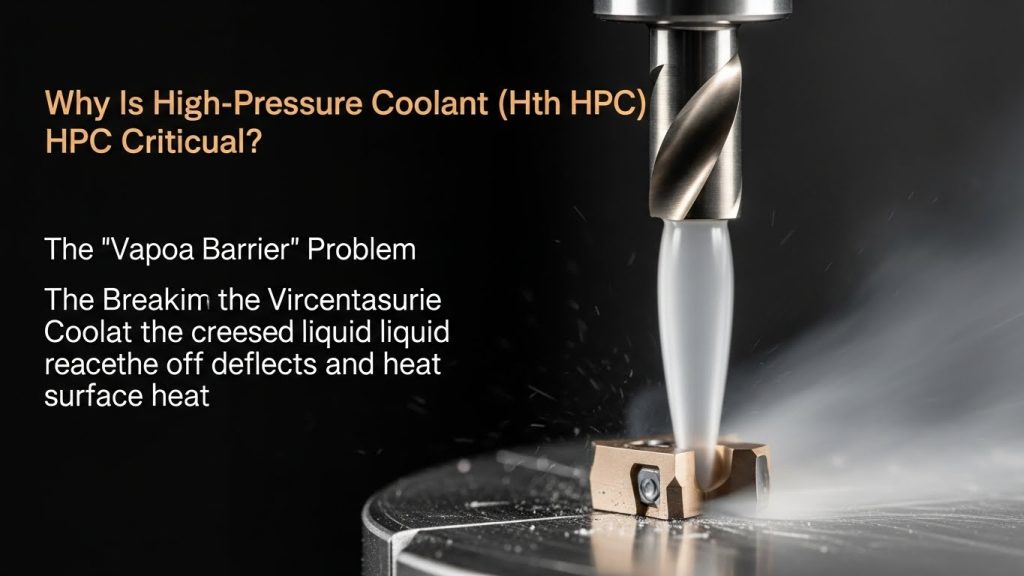
High-pressure coolant, ideally exceeding 300 PSI (20 bar), is critical for breaking chips and forcing them out of the flute gullets. In indexable drilling, pressure acts as a hydraulic ram that blasts chips away from the cutting edge, preventing them from re-cutting or packing, which is the leading cause of tool breakage.
Pressure is your insurance policy. Without it, you are gambling.
The “Vapor Barrier” Problem
When a drill spins at 3,000 RPM, it creates an air barrier around the tip. Low-pressure flood coolant just rides over this barrier and never touches the cut. High pressure punches through this vapor barrier to cool the insert directly.
If you are struggling with chips jamming in deep holes, refer to our guide on how to Improve Chip Evacuation in CNC Drilling. The solution is almost always more flow and pressure.
Flood Coolant vs. Through-Spindle Coolant (TSC): Which Is Better?
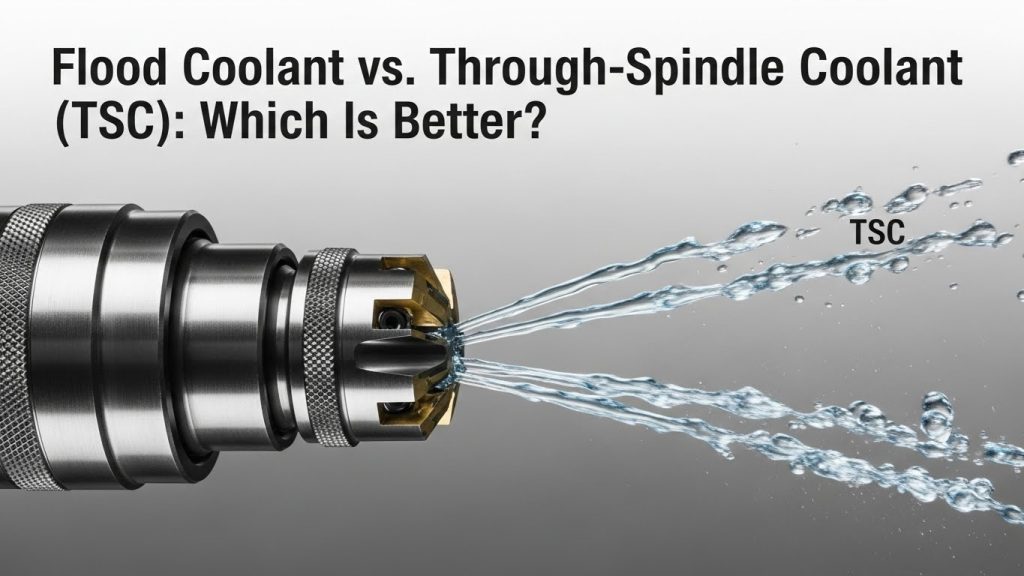
Through-spindle coolant (TSC) is mandatory for indexable drills deeper than 3xD to ensure fluid reaches the cutting zone. Flood coolant cannot penetrate deep holes against the centrifugal force of a spinning tool, causing the drill tip to run dry, overheat, and eventually fail due to chip welding.
Flood coolant is fine for spotting or very shallow holes. For everything else, you need TSC.
The Physics of Centrifugal Force
Imagine spinning a bucket of water. The water stays out. The same happens in a drilled hole. The spinning tool pushes fluid out.
- Flood: Cools the outside of the part.
- TSC: Cools the interface of the cut.
If your machine lacks TSC, you must use a peck cycle to allow fluid to enter. However, pecking with indexable drills can chip inserts. For strategies on managing this in mills, check our article on Indexable Drills in Machining Centers.
How Does Thermal Shock Destroy Carbide Inserts?
Thermal shock occurs when a hot carbide insert is suddenly cooled by intermittent fluid contact, causing rapid expansion and contraction that leads to “comb cracks.” To prevent this, the coolant supply must be continuous and copious; if consistent supply isn’t possible, running dry is sometimes safer than intermittent cooling.
This is the silent killer of inserts. You pull the tool out, and the edge looks like a saw blade.
Avoiding the Cycle of Death
- Engage Coolant Early: Turn coolant on before the drill enters the cut.
- Don’t Starve It: Ensure your pump doesn’t cavitate (sputter) mid-cut.
If you see micro-cracks perpendicular to the cutting edge, you have a thermal shock problem. This often leads to catastrophic failure where the insert shatters.
What Concentration Should You Run for Stainless Steel?
For tough materials like Stainless Steel (304/316) or Titanium, you should increase coolant concentration to 10-15% to increase lubricity. The added oil content reduces friction at the cutting edge, preventing Built-Up Edge (BUE) and reducing the work-hardening effect common in these alloys.
Running “lean” (3-5%) on stainless is a recipe for disaster.
The Danger of Built-Up Edge (BUE)
BUE happens when the material gets so hot and sticky it welds to the insert. This changes the geometry of the tool effectively making it dull.
- Rich Mix: The oil prevents adhesion.
- Lean Mix: The water cools, but doesn’t stop the sticking.
BUE increases cutting forces, which causes deflection. If your drill is wandering, check your concentration. This is a common cause of Off-Center Holes in Drilling.
Can Coolant Choice Impact Toolholder Life?
Yes, aggressive or poorly maintained coolants can degrade the rubber seals in hydraulic chucks and cause rust on pull-studs, destroying runout accuracy. Using a high-quality emulsion with rust inhibitors protects the delicate internal mechanisms of your toolholding system and ensures the drill remains concentric.
I have seen hydraulic chucks seize up because the coolant turned acidic and ate the seals.
Protecting Your Investment
Your toolholder is the bridge between the machine and the cut. If it rusts, you lose rigidity.
- Maintenance: Skim tramp oil.
- pH Level: Keep it between 8.5 and 9.2.
If you are using high-end holders, you must protect them. Read more about selecting the right interface in our guide on the Best Toolholders for Indexable Drills.
How Does Coolant Affect Vibration and Chatter?
Coolant acts as a lubricant that dampens the friction between the drill’s wear pads and the hole wall, effectively stabilizing the tool. If the coolant mix is too lean, the wear pads grind rather than glide, inducing chatter (vibration) that ruins surface finish and damages the machine spindle.
Many operators try to fix chatter by slowing down the RPM. Often, the fix is just adding more oil to the sump.
The Cushioning Effect
Indexable drills are unbalanced forces. The wear pads support the drill.
- Good Lubricity: The pads hydroplane on a film of oil.
- Bad Lubricity: Metal-on-metal contact.
If your drill is screaming, check your refractometer before you change the feed rate. For more mechanical solutions to vibration, review How to Avoid Chatter During Indexable Drilling.
Checklist: Is Your Coolant System Ready?
Before you hit the green button, run through this list.
| Factor | Target | Why it matters |
| Concentration | 8% – 12% | Balances cooling and lubricity. |
| Pressure | >300 PSI | Breaks chips and punches vapor barrier. |
| Filtration | <20 Microns | Prevents recutting chips. |
| Condition | No bacteria/Tramps | Protects seals and health. |
| Delivery | Through-Spindle | Ensures fluid hits the tip. |
Does Filtration Matter for Indexable Drilling?
Yes, proper filtration is essential because recirculating fine chips (fines) in the coolant will sandblast the drill body and ruin the surface finish. Filtration units should remove particles down to 20 microns to ensure that only clean fluid reaches the high-pressure pump and the cutting interface.
Dirty coolant kills pumps and tools.
The “Sandblasting” Effect
If you are drilling deep holes, you need the fluid to flush chips out. If you are pumping chips in, you are abrading the hole wall. This leads to poor Ra values.
To maintain a pristine environment, ensure your entire machine setup promotes cleanliness. See our CNC Setup Optimization Guide for foundation tips.
Summary
So, what coolant works best for indexable drilling?
It is a water-soluble emulsion, mixed rich (8-12%), delivered through the spindle at high pressure (>300 PSI).
Do not neglect this variable. You can buy the most expensive drill body and the best carbide grades, but if you feed them lean, low-pressure coolant, they will fail.
Treat your coolant like a tool component. Measure it, maintain it, and optimize it.
Frequently Asked Questions
1. What is the best coolant concentration for indexable drilling? The ideal concentration is typically between 8% and 12%. This range ensures adequate lubricity for the drill’s wear pads while maintaining the cooling properties of water to prevent thermal damage to the carbide inserts.
2. Is through-spindle coolant necessary for indexable drills? Yes, through-spindle coolant (TSC) is highly recommended, and mandatory for holes deeper than 3x diameter. It ensures coolant reaches the cutting edge to evacuate chips and manage heat, which flood coolant cannot do effectively.
3. Can I use neat oil for indexable drilling? Yes, neat oil provides excellent lubricity and surface finish, making it great for deep holes or superalloys. However, it dissipates heat slower than water, so you must typically reduce your spindle speed (RPM) to prevent overheating.
4. What causes thermal shock in carbide inserts? Thermal shock is caused by rapid temperature changes, such as when a hot insert is hit by a splash of cold coolant. This creates “comb cracks.” To avoid this, coolant flow must be continuous and high-volume, never intermittent.
5. How much coolant pressure do I need for drilling? For indexable drilling, a minimum of 300 PSI (20 bar) is recommended. Higher pressure (1000 PSI+) is even better as it helps break chips into small pieces and blasts them out of the hole, preventing jamming.
6. Why does my coolant smell bad? Bad smells are caused by bacterial growth, usually due to low concentration or high tramp oil (leakage from machine slideways). Maintain your concentration above 8% and use a skimmer to remove tramp oil to keep bacteria in check.
