







How Indexable Drills Improve Productivity
In my 15 years on the shop floor, I’ve seen more money wasted on “regrind logistics” than almost any other tooling category. You know the drill (pun intended): you buy a premium solid carbide drill, it runs beautifully for 2,000 holes, and then it dulls.
Now, that expensive piece of carbide sits in a bin waiting for the tool crib manager to batch it out to the sharpening vendor. It comes back two weeks later, slightly shorter, requiring you to reset all your tool offsets. Meanwhile, your spindle has been sitting idle—or worse, you’ve had to buy three backup drills just to keep production running.
This is where indexable drills change the math. They aren’t just tools; they are a cycle-time reduction strategy. By moving the “re-sharpening” process directly into the machine envelope (simply by rotating an insert), you eliminate the logistical drag that kills productivity.
At Accurate Cut, we’ve helped industries ranging from aerospace to general job shops transition from solid tooling to comprehensive indexable drilling systems, and the result is almost always the same: lower inventory costs and higher metal removal rates. Here is exactly how they work—and why your competitors are already using them.
What Is an Indexable Drill? (And How It Differs)
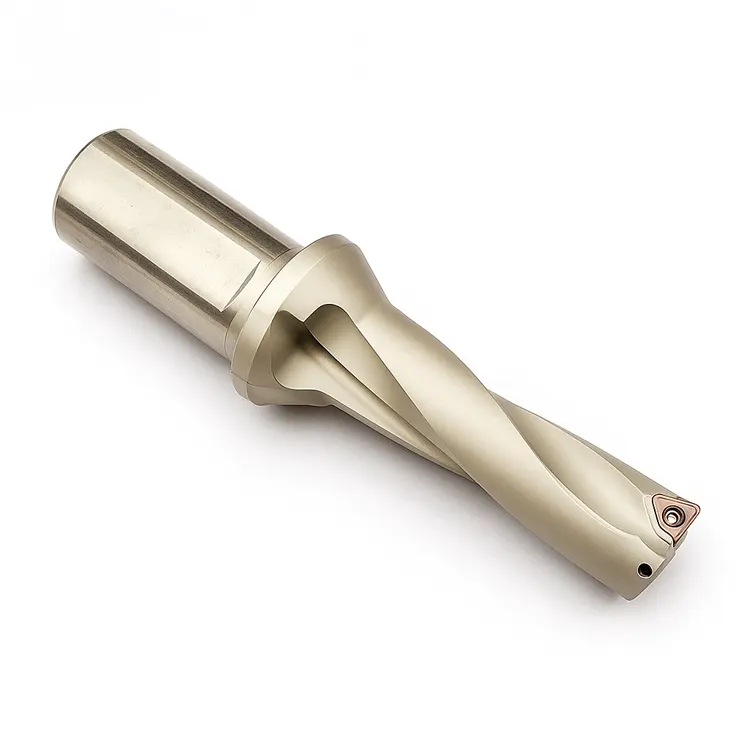
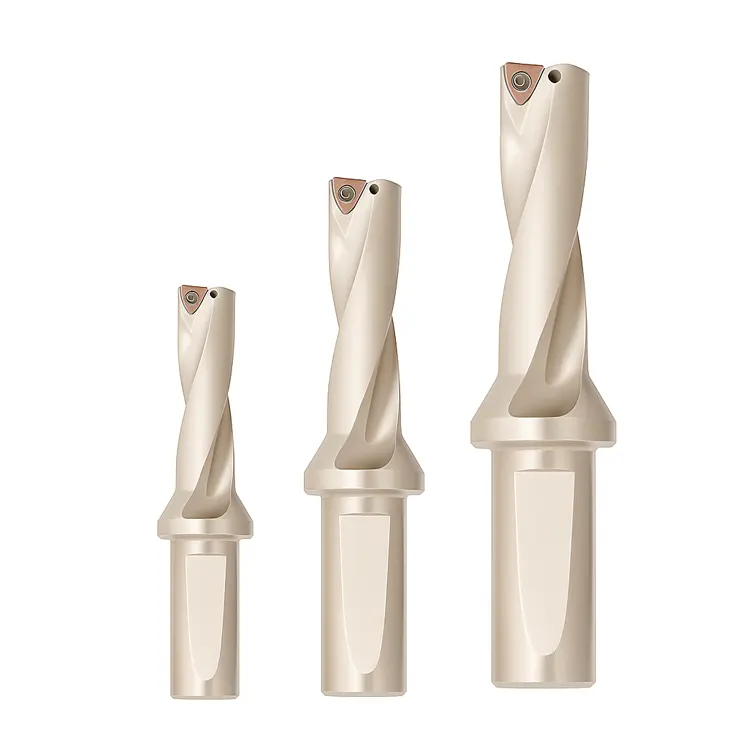
For those new to high-performance tooling, learning what an indexable drill is starts with the anatomy: a hardened steel body that holds two (sometimes four) replaceable carbide inserts.
- The Central Insert: Cuts the center of the hole (zero surface speed area).
- The Peripheral Insert: Cuts the outer diameter and determines the final hole size.
Here is a quick breakdown of solid vs. indexable drills:
| Feature | Solid Carbide Drill | Indexable Drill |
| Structure | One solid piece of carbide | Steel body + Carbide inserts |
| Failure Mode | Catastrophic snap (often ruins part) | Insert wear or screw strip (body usually survives) |
| Regrinding | Required (shipping + wait time) | None (Index/Swap insert in 2 mins) |
| Cost | High initial + High maintenance | High body cost + Very low insert cost |
| Best For | Tight tolerances (H7), Small holes | Roughing, Fast material removal, Versatility |
The Three Pillars of Productivity
When we talk about productivity, we aren’t just talking about spindle speed. We are talking about Process Reliability and overall CNC efficiency.
Reduced Downtime (The “Spindle Uptime” Argument)
The biggest productivity killer isn’t slow feed rates; it’s setup time. In my experience, changing a worn solid carbide drill takes about 10–15 minutes. You have to remove the holder, swap the drill, measure the new stick-out length, and update the tool offset in the CNC controller.
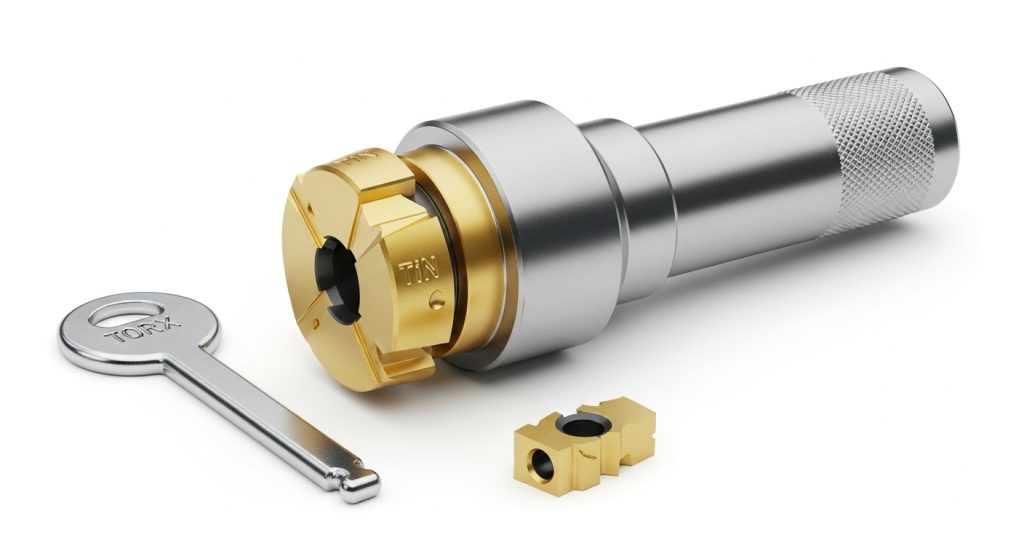
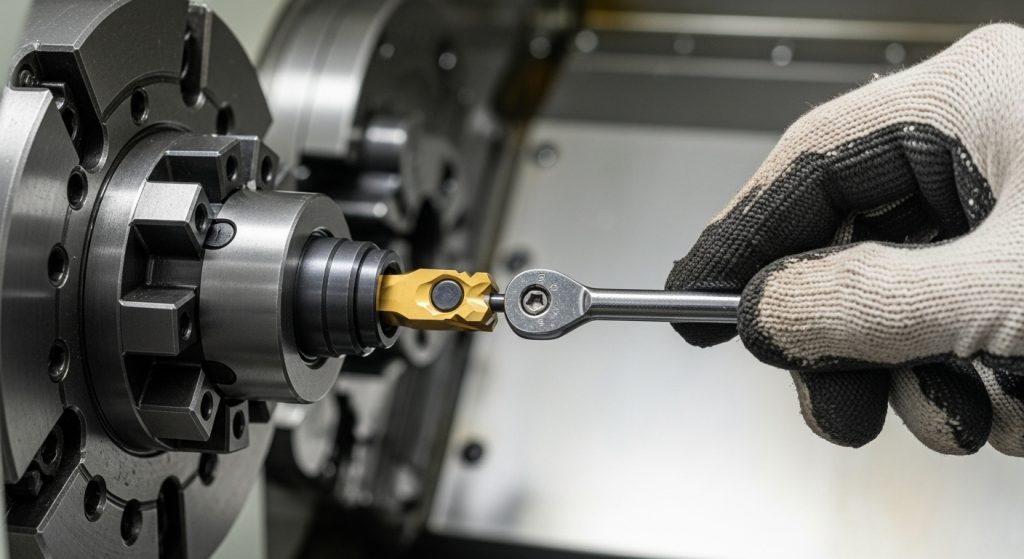
With an indexable drill, you don’t remove the tool from the turret. You open the door, loosen the Torx screw, rotate the insert to a fresh edge, torque it down, and hit “Cycle Start.”
- Time taken: 90 seconds.
- Offsets changed: Zero.
Higher Metal Removal Rates (MRR)
Indexable drills are built for aggression. Because the steel body is tougher than brittle carbide, these tools can handle significant feed forces.
- Fact: In 4140 steel, a modern indexable drill can often run at 3x the feed rate of a standard High-Speed Steel (HSS) drill.
- Data: We often see Metal Removal Rates (MRR) jump from 20 cm³/min (HSS) to over 150 cm³/min (Indexable) in roughing applications.
Inventory Management
This is what most suppliers won’t tell you: Solid carbide drills are a cash-flow nightmare. If you drill 12mm, 12.5mm, and 13mm holes, you need backups for each size.
With an indexable system, one drill body (e.g., a 20mm shank) can often hold inserts that cut a range of diameters, or at the very least, you only need to stock one type of insert grade (e.g., TiAlN coated) to cover all your drill bodies.
Cost Analysis: Calculating the “Cost Per Hole”
Many shop owners balk at the price of an indexable drill body, which can cost $300–$600. But this is short-term thinking.
Let’s do the math:
- Scenario: Drilling 5,000 holes in 304 Stainless Steel.
- Solid Carbide: Costs $150. Lasts 500 holes. Requires 4 regrinds ($20 each) before it’s scrap.
- Total Tooling Cost: You need ~2 new drills + regrinds = ~$400+
- Indexable: Body costs $350 (amortized over 50,000 holes). Inserts cost $15 per edge. Each edge lasts 400 holes.
- Total Tooling Cost: Body cost is negligible per hole. You use ~12 insert edges ($180).
- Total Savings: ~50% cheaper on consumables alone.
Versatility on the Shop Floor (The Hidden Benefit)
Here is a trick I’ve used on CNC lathes that you simply cannot do with solid carbide.
Offset Drilling (The “X-Axis Shift”)
On a lathe, because the drill is stationary and the part is rotating, you can offset the drill in the X-axis to change the hole size.
- Need a 24.2mm hole but only have a 24.0mm indexable drill?
- Shift the X-axis by 0.2mm. The peripheral insert will cut the larger diameter.
- Note: This creates a “pip” in the center, but for through-holes, it’s a lifesaver.
Boring and Chamfering
Because the inserts are essentially turning tools, you can use an indexable drill as a boring bar. After drilling the hole, you can leave the tool in the hole and drag it back in Z and X to bore a precise finish diameter or even add a chamfer. Try doing that with a twist drill!
When NOT to Use Indexable Drills
I believe in being transparent. Indexable drills are “roughing animals,” not “finishing artists,” and understanding indexable drill geometry and hole quality is crucial.
- Tolerance Limitations: Indexable drills typically hold a tolerance of +/- 0.1mm (0.004″). If your print calls for H7 or tight press-fits, you must follow up with a reamer or boring bar.
- Length-to-Diameter Ratio: Once you go deeper than 4xD or 5xD, indexable drills can struggle with chatter due to the deflection of the steel body. Solid carbide is much stiffer for deep holes (8xD+).
- Small Diameters: Below 12mm (approx 1/2 inch), the screws required to hold the inserts become too small and fragile. Stick to solid carbide for small holes.
Best Practices for Maximizing Tool Life
If you buy an indexable drill from Accurate Cut and it fails, 9 times out of 10, it’s due to ignoring critical features that matter like coolant volume or entry methods.
Coolant Pressure is King
Chips from an indexable drill are fast and hot. If they don’t get flushed out immediately, they will recut (get trapped between the body and the wall), welding themselves to the drill body.
Rule of Thumb: You generally need Through-Spindle Coolant (TSC) at a minimum of 150 PSI (10 Bar). For stainless steel, 300+ PSI is ideal.
“Listen” to the Cut
An experienced machinist knows the sound.
- Consistent Hum: Good cut.
- High-Pitched Screech: Peripheral insert is worn (rubbing).
- Deep/Rumbling Crunch: Central insert is failing or chips are packing. Hit E-Stop immediately.
Entry and Exit
When drilling into convex surfaces (like a round bar), reduce your feed rate by 50% until the full diameter of the drill is engaged. This prevents the drill from “walking” or deflecting before the peripheral insert bites.
FAQ
What is the difference between a spade drill and an indexable drill?
A spade drill uses a single, large replaceable blade (HSS or Carbide) clamped into a slot. It is generally slower but better for very large, deep holes (up to 100mm+ diameter). Indexable drills use small individual carbide inserts and are much faster but limited to shallower depths (typically up to 5xD).
Can I use indexable drills on a manual lathe?
Technically yes, but I don’t recommend it. Indexable drills require high RPM and high coolant pressure that manual machines rarely provide. They also lack the safety enclosure needed when hot chips are flying at 2,000 RPM.
How many times can I rotate an indexable insert?
Most modern inserts are square (4 edges) or triangular (3 edges). Always check the insert seat clean before rotating. A tiny chip trapped under the insert will crack it instantly upon tightening.
Why is my indexable drill making a screeching noise?
This usually indicates flank wear on the peripheral (outer) insert. Because the outer insert travels at the highest surface speed, it wears out faster than the central insert. Swap it out before it destroys the tool body.
What is the minimum coolant pressure for indexable drills?
For shallow holes (2xD), you might get away with flood coolant. For 3xD or deeper, you need through-tool coolant at 150 PSI minimum. Without it, you risk chip packing and catastrophic tool body failure.
Conclusion
Switching to indexable drills is one of the fastest ways to modernize a machine shop. You reduce the cash tied up in inventory, you eliminate the headache of regrinding, and most importantly, you keep your spindles turning and earning.
While they aren’t the solution for every sub-millimeter precision hole, for the vast majority of roughing work over 12mm, they are the industry standard for a reason.
Ready to optimize your hole-making process? Stop wasting time on regrinds. Browse Accurate Cut’s selection of high-performance indexable drills today and see the difference in your cost-per-part immediately.
