







What Inserts Are Best for Alloy Steel: The Definitive Machining Guide
Finding the right insert for alloy steel is the single most critical factor in reducing cycle time and preventing catastrophic tool failure. If you choose the wrong grade or geometry, you aren’t just losing money on tooling; you are sacrificing machine uptime. Alloy steels (ISO P) present unique challenges due to their high tensile strength and toughness. This guide cuts through the noise to give you the specific grades, coatings, and geometries required for peak performance.
What Is the Best Insert for Alloy Steel?
Quick Answer:
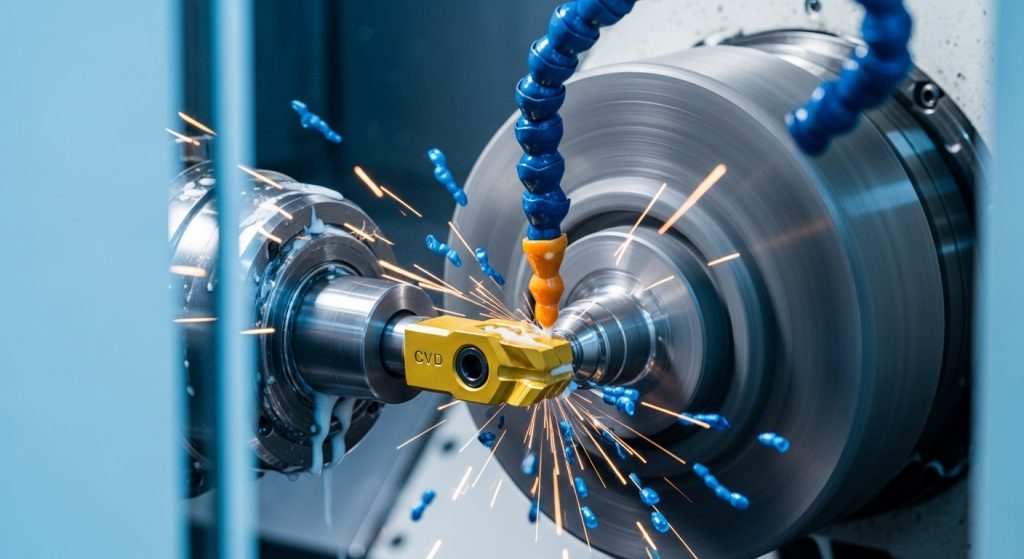
The best insert for alloy steel generally falls within the ISO P15 to P25 range. Look for a CVD-coated carbide insert with a titanium carbonitride (TiCN) and aluminum oxide (Al2O3) layer. This combination offers the necessary balance of toughness to resist shock and hardness to withstand the heat generated during machining. For finishing, choose a P10 grade; for heavy roughing, a P35 grade is superior.
Understanding ISO P Classification for Alloy Steels
To select the correct tool, you must first respect the material properties. Alloy steels contain elements like manganese, silicon, nickel, and chromium. These additions increase hardness and toughness compared to standard carbon steel.
When we talk about ISO P, we are referring to the color-coded blue group in machining. While standard carbon steel is predictable, alloy steel tends to work-harden. This generates excessive heat at the cutting edge.
Key Selection Criteria:
- Heat Resistance: The insert must not deform plastically under high temperatures.
- Toughness: It must withstand interrupted cuts without chipping.
- Chemical Stability: It needs to resist crater wear caused by chemical reactions between the steel and the carbide.
If you are accustomed to softer materials, check our material-based drilling guides to see how alloy steel demands a distinct approach compared to non-ferrous metals.
Which Insert Grade Should You Use: P10, P20, or P30?
Quick Answer:
Select P10 grades for continuous finishing operations where speed and surface finish are priorities. Use P20 grades as your “general purpose” solution for medium machining with moderate interruptions. Choose P30 or P35 grades for heavy roughing, interrupted cuts, or unstable setups where maximum toughness is required to prevent insert breakage.
The “P” Scale Explained
The ISO P scale is your roadmap. Manufacturers might have fancy proprietary names, but they all map back to this scale.
1. P05 – P10: High Speed, Continuous Cuts (Finishing)
These inserts are hard. Very hard. They are designed for high cutting speeds and light depths of cut.
- Best for: Final passes on 4140 or 4340 steel.
- Weakness: They are brittle. If you have a heavy interrupted cut, a P10 will shatter.
- Comparison: Unlike the tooling discussed in our guide on how to drill carbon steel indexable tools, P10 inserts for alloy steel require rigid setups to avoid vibration-induced failure.
2. P20 – P25: The Universal Grade (Semi-Finishing/Medium)
If you run a job shop and don’t know exactly what steel is coming in next, keep P25 inserts in stock. They offer a compromise. They handle varied depths of cut and moderate feed rates well.
3. P30 – P40: Heavy Roughing (Toughness)
These are the workhorses. They utilize a tougher carbide substrate with a specialized coating to handle mechanical shock.
- Scenario: Machining a forging with a hard skin or scale.
- Advantage: They prioritize edge security over cutting speed.
Table: Recommended Speeds and Feeds by Grade (Estimated)
| Grade | Application | Cutting Speed (Vc) | Feed Rate (fn) | Depth of Cut (ap) |
| P10 | Finishing | 250-350 m/min | 0.10 – 0.25 mm/rev | 0.5 – 2.0 mm |
| P20 | Medium | 200-280 m/min | 0.25 – 0.40 mm/rev | 2.0 – 4.0 mm |
| P35 | Roughing | 140-200 m/min | 0.40 – 0.70 mm/rev | 4.0 – 8.0 mm |
CVD vs. PVD Coatings: Which Is Better for Alloy Steel?
Quick Answer:
CVD (Chemical Vapor Deposition) is generally better for turning alloy steel because it allows for thicker coatings that provide superior heat resistance and crater wear protection. PVD (Physical Vapor Deposition) is preferred for milling, threading, or finishing operations where a sharper cutting edge and adhesion are required to prevent built-up edge (BUE).
The Heat Factor
Alloy steel generates immense heat.
- CVD Coatings: These are thick (10-20 microns). The typical layering involves Titanium Carbonitride (TiCN) for wear resistance and Aluminum Oxide (Al2O3) as a thermal barrier. This forces the heat into the chip, not the tool.
- PVD Coatings: These are thinner (2-5 microns). They create compressive stress on the insert surface, which makes the edge tougher.
Pro Tip: If you are turning gummy stainless steels alongside your alloy steels, check our best drills for stainless steel guide, as the coating requirements often overlap with PVD preferences.
How Does Geometry Impact Chip Control?
Quick Answer:
Geometry determines chip breaking. For alloy steel, use a double-sided negative insert (like a CNMG or WNMG) for roughing to maximize edge strength. For finishing, use a positive geometry (like a CCMT) to reduce cutting forces. Ensure the chipbreaker is tight enough to curl the chip but open enough to prevent clogging.
Solving the “Bird’s Nest”
Alloy steel is ductile. Without the right geometry, you will get long, stringy chips that wrap around the chuck. This is dangerous and ruins surface finish.
- Roughing Geometries: Look for open chipbreakers with strong lands (the area behind the cutting edge). You want to direct the cutting force downward into the tool holder.
- Finishing Geometries: These have sharp cutting edges and aggressive chip breakers designed to snap the chip even at low depths of cut.
Note: Unlike how to drill cast iron, where chips naturally crumble into powder, alloy steel requires active mechanical chip breaking from the insert geometry.
When Should You Use Cermet or Ceramic Inserts?
Quick Answer:
Use Cermet for high-speed finishing of alloy steels where surface finish quality is critical and tolerances are tight. Use Ceramic inserts only for hardened alloy steels (45-65 HRC) to achieve extreme removal rates, but avoid them for interrupted cuts due to their brittleness.
Beyond Carbide
Standard carbide handles 80% of jobs. But for the top 20%:
- Cermet (Ceramic + Metal): These maintain their hardness at higher temperatures than carbide. They resist “smearing” and chemical wear. If you need a mirror finish on a 4140 shaft, swap your P10 carbide for a Cermet grade.
- CBN (Cubic Boron Nitride): If the alloy steel is hardened (like a case-hardened gear), carbide will fail instantly. CBN is the only viable option for turning hardened steel efficiently.
Troubleshooting: Why Is My Insert Failing?
Quick Answer:
Identify the wear pattern. Crater wear indicates excessive speed or heat; switch to a thicker Al2O3 coating. Chipping indicates the grade is too hard; switch to a tougher P30/P35 grade. Built-up Edge (BUE) means the speed is too low or the edge is not sharp enough; increase Vc or switch to PVD.
Reading the Tea Leaves (Wear Patterns)
I have seen countless bins filled with “dead” inserts that still had 40% life left, or inserts that exploded because the operator ignored the warning signs.
- Flank Wear: Predictable and desired. If it happens too fast, use a harder grade.
- Plastic Deformation: The edge is drooping. The heat is too high. Reduce speed or use a better heat-resistant coating (CVD).
- Thermal Cracking: Caused by temperature fluctuation. This often happens when coolant is applied intermittently. Advice: Turn the coolant off completely or flood it at high pressure. No dribbling.
Final Thoughts on Alloy Steel Inserts
Selecting the right insert for alloy steel is a balance of science and art. Start with the ISO P classification. Use P20/P25 as your baseline. If the tool wears too fast, move to P10. If it chips, move to P30. Always monitor the chips—they tell you the story of what is happening inside the cut.
By optimizing your insert selection, you don’t just save on consumable costs; you unlock the full potential of your CNC machinery.
