







How Indexable Drills Reduce Tooling Costs

There is a specific sound that makes every shop owner’s stomach drop. It’s not the hum of the spindle or the rhythmic thumping of a punch press. It’s the sudden crunch-snap of a solid carbide drill breaking deep inside a nearly finished part.
In that split second, you haven’t just lost a $150 tool. You’ve likely scrapped a $500 part, paused a machine that costs $100 an hour to run, and sent an operator scrambling to the tool crib to find a replacement that—hopefully—is in stock.
If you’ve been in manufacturing as long as I have, you know that “tooling cost” isn’t just the price on the invoice. It’s the Total Cost of Ownership (TCO). While solid carbide drills have their place (specifically in small diameters), relying on them for larger holes is often like burning money to keep the lights on.
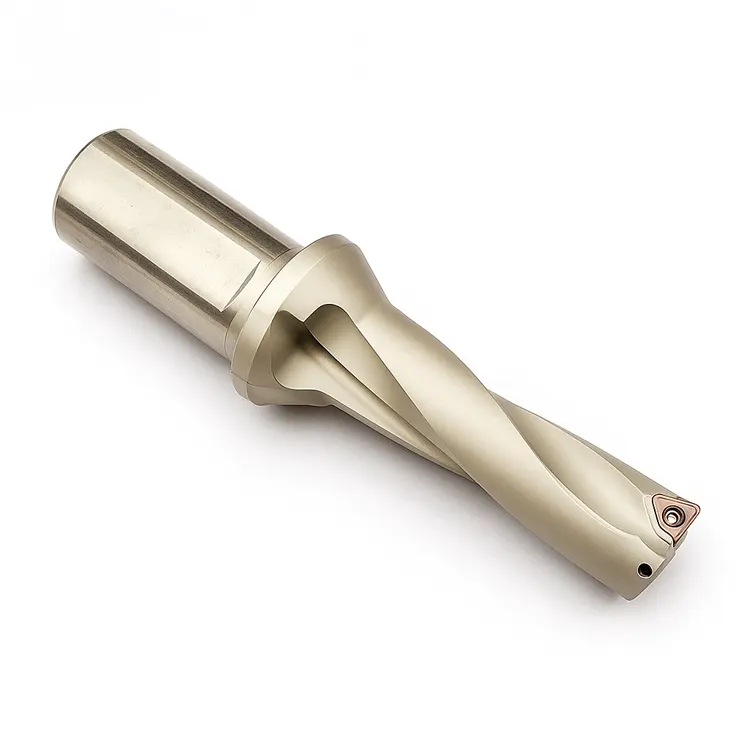
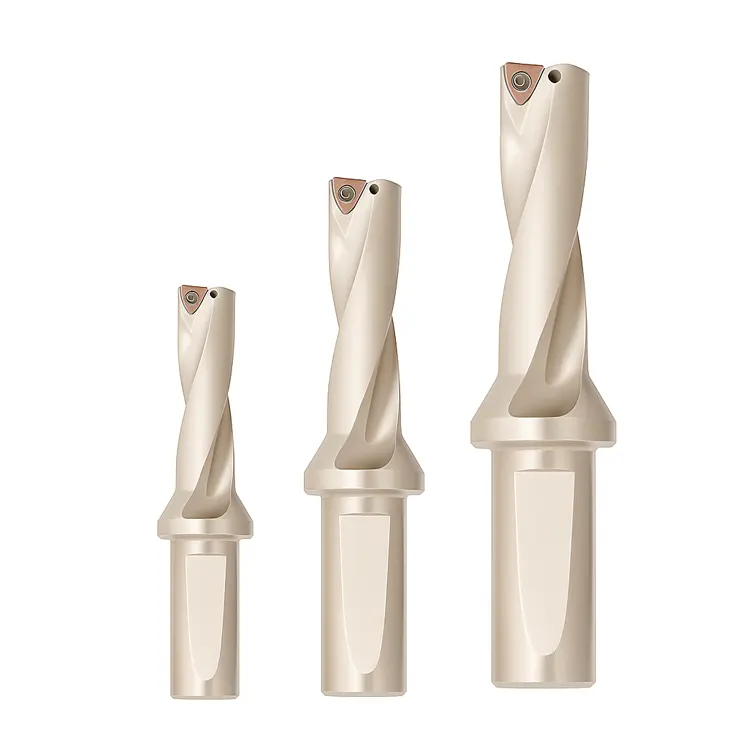
In this indexable drilling guide, we’re going to strip away the marketing fluff and look at the hard economics. We’ll explore how indexable drills—systems using a steel body and replaceable carbide inserts—fundamentally change the math of hole-making, shifting your spend from “consumable tools” to highly efficient “consumable edges.”
The Economics of Modular Tooling: Body vs. Inserts
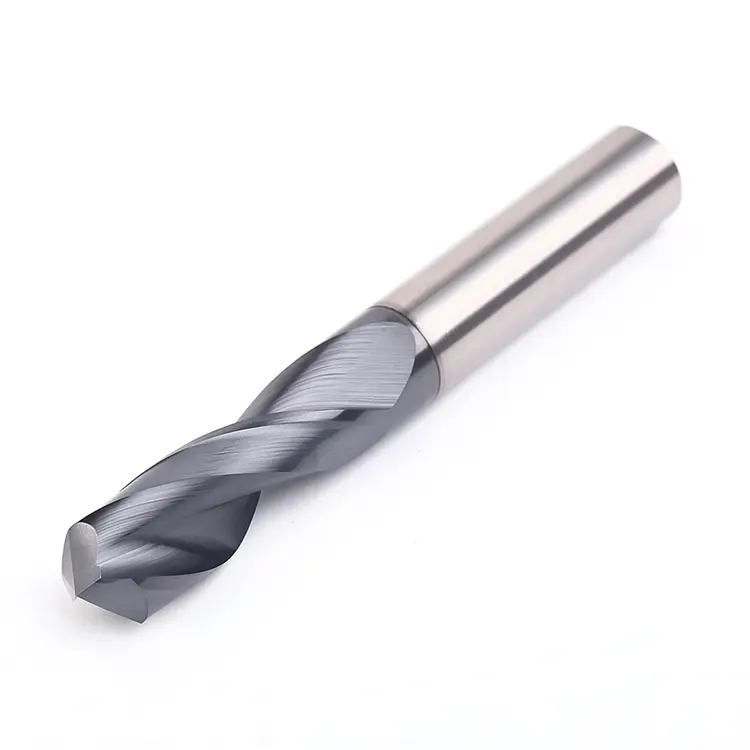
To understand where the savings come from, you have to look at the anatomy of the tool. With a solid carbide drill, you are paying for a premium material—sub-micrograin carbide—from the tip all the way to the shank.
But here’s the thing: the shank doesn’t cut. It just holds the tool in the holder. So why are you paying for expensive carbide to do a job that cheap steel can do better?
Indexable drills operate on what we in the industry call a “modular system.”
- The Steel Body: This is your capital asset. It’s made of tool steel, which is significantly tougher than carbide. It absorbs vibration and shock, meaning it won’t snap under the side loads that would shatter a solid carbide drill. A good body can last for hundreds, sometimes thousands, of holes.
- The Carbide Inserts: These are the “blades.” One of the major advantages of replaceable inserts is that because they are small, manufacturers can use higher grades of carbide and more complex coatings (like TiAlN or AlCrN) without driving up the cost.
The Bottom Line: When an edge wears out on an indexable drill, you aren’t throwing away the tool. You are rotating a $15 insert.
Eliminating the “Hidden Factory” of Regrinding
If I had a nickel for every time a shop manager told me, “Solid carbide is cheap because we regrind it,” I’d retire.
Regrinding is the biggest hidden cost in drilling. It creates a “hidden factory” of administrative waste that most shops never bother to track. Let’s look at what actually happens when you rely on regrinds:
The Logistics Nightmare
When a solid drill dulls, you have to pull it, clean it, box it, fill out a purchase order, ship it to a grinding house, wait two weeks, and process it back into inventory. That is hours of administrative labor for a “savings” that is often negligible.
The Z-Offset Killer
This is the technical deal-breaker. When a solid carbide drill comes back from the grinder, it is shorter. It might be 0.050″ shorter, or it might be 0.100″ shorter.
This means you cannot simply drop it back into the machine and hit “Cycle Start.” The operator has to measure the tool length offset and update the CNC controller. If they forget? You crash the machine or drill a blind hole too shallow.
The Indexable Advantage:
Indexable inserts are manufactured to ISO tolerances. When you swap an insert, the tool length (Z-offset) remains identical.
- No re-measuring.
- No touching off.
- No program edits.
You can change inserts right inside the machine in about 30 seconds. Compare that to the 10-15 minutes it takes to swap, measure, and test a reground solid drill. Over a year, those minutes add up to days of lost production.
Boosting Throughput: Why Speed Equals Savings
In manufacturing, time is the only resource you can’t buy more of.
When we talk about reducing costs, we often focus too much on the tool price and not enough on the Machine Burden Rate. If your machine costs $80/hour to run, saving $10 on a tool is meaningless if it forces you to run the cycle 20% slower.
This is exactly how indexable drills improve productivity: they are generally capable of higher Metal Removal Rates (MRR) in diameters above 0.75″ (19mm).
- Chip Evacuation: The flutes on an indexable body are generally larger and polished, allowing for aggressive chip evacuation.
- Feed Rates: Because the steel body is tough, you can push the feed rates (IPM) harder without fear of catastrophic snapping.
Real-World Scenario
I once worked with a shop drilling 4140 steel. They were babying a solid carbide drill at 8 inches per minute (IPM) because they were terrified of breaking it. We switched to a standard 2xD indexable drill. Because the inserts were cheap and the body was tough, they felt confident pushing the feed to 12 IPM.
They reduced the cycle time by 33%. On a run of 5,000 parts, that saved them 40 hours of machine time. At $100/hour shop rate, the indexable drill saved them **$4,000** on that one job. The cost of the inserts was a rounding error compared to that.
The Math: Calculating Cost Per Hole (CPH)
Let’s stop talking abstractly and look at the math. To determine the true value, you need to calculate the Cost Per Hole (CPH).
The formula looks like this:
CPH = (Tool Cost + (Machine Cost × Time)) / Total Holes Produced
Let’s compare a 1-inch (25.4mm) hole drilled in mild steel.
Option A: Solid Carbide Drill
- Tool Cost: $280
- Tool Life: 800 holes (before regrind/failure)
- Machine Cost: $1.50 per minute
- Cycle Time: 30 seconds
Option B: Indexable Drill
- Body Cost: $350 (amortized over 5,000 holes = $0.07/hole)
- Insert Cost: $30 (2 inserts @ $15 each)
- Insert Life: 400 holes per edge (4 edges total) = 1,600 holes per set
- Cycle Time: 25 seconds (faster feed)
| Metric | Solid Carbide | Indexable Drill |
| Tool Cost per Hole | $0.35 | $0.09 (Inserts + Body Amortization) |
| Machine Cost per Hole | $0.75 | $0.62 |
| TOTAL COST PER HOLE | **$1.10** | $0.71 |
The Result: The indexable drill is 35% cheaper per hole. On a production run of 10,000 holes, that is nearly $4,000 in pure profit staying in your pocket.
Inventory Management and Cash Flow
Here is something your CFO will love.
To keep a high-production line running with solid carbide, you need significant inventory depth. You typically follow the “Rule of 3”:
- One in the spindle.
- One in the regrind bin.
- One fresh backup on the shelf.
If you are running a $300 drill, that’s nearly $1,000 tied up in inventory for one tool size. If you drill 20 different sizes, you have $20,000 sitting in a drawer doing nothing.
With indexable drills, you need one body on the machine and a small box of inserts in the drawer. That box of inserts might cost $150, but it provides the cutting equivalent of 5 solid drills. You drastically reduce the capital tied up in inventory, freeing up cash flow for things that actually grow your business.
When NOT to Use Indexable Drills
I want to be transparent here because at Accurate Cut, we believe in using the right tool for the job. Indexable drills are amazing, but they are not magic wands. Understanding what features matter most in indexable drills will help you decide when to stick with solid carbide.
1. Small Diameters (< 0.500″ / 12mm)
Physics is the limitation here. To make an indexable drill, you need to screw an insert into the steel body. Below 1/2 inch, the screws become so tiny they strip easily, and the core of the steel body becomes too thin to handle the torque. For small holes, solid carbide is still king.
2. Tight Tolerances without Reaming
Indexable drills are roughing tools. They are designed to remove metal fast. They generally hold a tolerance of +/- 0.005″ to 0.010″. If you need a hole with an H7 tolerance, an indexable drill won’t get you there in one shot. You will need to drill and then ream or bore. Solid carbide drills can often hold tighter tolerances directly.
3. Weak Setups
Indexable drills exert significant radial (side) pressure. If you are working on a flimsy setup or an older lathe with loose ways, the drill might “walk” or chatter. Solid carbide is generally more self-centering.
Conclusion
The shift from solid carbide to indexable drilling isn’t just a change in tooling; it’s a change in mindset. You are moving away from a model of expensive consumables and erratic regrind cycles to a model of stability, speed, and predictability.
By eliminating the regrind loop, you stabilize your Z-offsets and streamline automation. By increasing feed rates, you reduce machine burden costs. And by optimizing inventory, you stop letting your capital gather dust on a shelf.
The goal isn’t to buy the cheapest tool. It’s to produce the cheapest hole.
Ready to optimize your production?
Browse Accurate Cut’s selection of high-performance indexable drills today and stop paying for chips you’ve already made.
Frequently Asked Questions
Quick Answer: Do indexable drills save money?
Yes, for holes larger than 0.5 inches (12.7mm). While the initial drill body costs more, the low cost of replacement inserts and the elimination of regrinding fees typically result in a 30-50% reduction in cost-per-hole compared to solid carbide.
What is the minimum diameter for indexable drills?
Typically, the viable minimum diameter is around 0.500″ (12.7mm) or 0.625″ (16mm) depending on the manufacturer. Below this size, the screws required to hold the inserts are too small to be reliable, and the drill body lacks sufficient core strength.
Do indexable drills require center drilling?
Generally, no. Modern indexable drills (like the SPMG or WCMX styles) are designed to self-center. However, if you are drilling into a curved surface or an uneven casting, spot drilling or milling a flat patch first is recommended to prevent the tool from walking.
Can you use indexable drills on a lathe?
Absolutely. In fact, they are incredibly versatile on CNC lathes. Unlike solid drills, an indexable drill can be used as a boring bar after drilling the hole (X-axis shift), allowing you to drill and finish bore a hole using the same tool, saving a tool station.
How do I calculate cost per hole?
The simplified formula is:
(Tool Cost + (Machine Hourly Rate / 60 * Cycle Time Minutes)) / Number of Holes.
Don’t forget to include the “hidden” costs for solid carbide, such as shipping for regrinds and the time spent measuring tool offsets.
